
Out for an early morning walk just before sunrise this morning, the thick, heavy air made it feel like I was walking through pancake batter. As is often the case on these muggy summer mornings, I was literally wrapped in humidity. The heavy air muffled almost all the sounds around me, like an unwelcome blanket. As I walked, the only sounds I could really distinguish were my own footsteps on the pavement, my struggled breathing, and my neighbor’s pathetic old rooster, with his weak, sub-urbanized attempt at calling up the sunrise.
Then, faintly through the pall, I heard one of my favorite sounds in the world – the blasts of a train locomotive’s horn, far off in the distance. In my mind, I tried to guess his location and direction…headed east, probably over at Collier Cemetery Road, or perhaps crossing through Keenan Cutoff just now. I smiled as I imagined the excited stream of sound waves, powerfully kicked to freedom by the rush of compressed air through the end of that train’s trumpet, only to be immediately suppressed and slowed by the wall of dense air in front of them.
After swimming through the soup, the faint musical tones of the train’s horn finally found my ears. What a difference from the winter months, when the air is so light and crisp that a blast from a train over 2 miles away can literally sound like a Union Pacific locomotive is parked in my backyard.
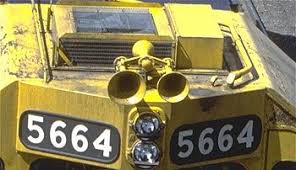
Train horns are interesting to me. They’re big, they’re loud. They have to be big and loud just to be capable of announcing the huge agglomeration of steel and energy they are mounted to, as it rumbles through the towns and cities of our nation. Here is the Nathan AirChime K5LA, the one most commonly used on today’s locomotives – “the godfather of all train air horns”
If you’ve ever really listened to the sounds of train horns, you may have noticed that there is a definite system in place, a language being spoken that is defined by the length of the blasts as the engineer opens the air valve and blows the horn. The most commonly heard sequence is the one we hear when we’re sitting at a grade crossings – “LONG….LONG….SHORT….LOOOONG”. Starting in 2005, the Federal Railroad Administration (FRA) dictated that this pattern of blasts (L – L – S – L) be sounded “at least 15 seconds but not more than 20 seconds before entering a crossing, and repeated as necessary until the lead locomotive fully occupies the crossing blah blah blah”. (blah’s added by me for emphasis).
You might expect this type of unbending specificity from the railroad. After all, our railroad system is probably one of the most regulated parts of our nation’s transportation system. The very nature of the railroad is conformity and rigidity – two steel rails guiding a set of rigid steel wheels between them. No room for non-conformity here! It follows that even the whistle-blowing would be tightly regulated.
So no matter where you go in the U.S., if you get caught at a railroad crossing and the train is approaching, you’ll likely hear the same phrase from the engine’s horn….LONG….LONG….SHORT….LOOOOONG.
How boring! We need to change this.
Those of you who know me well know that one thing on my bucket list in life is to someday ride in a train locomotive…perhaps even drive one. I realize that the chances of this ever happening are slim to none, but I keep it on my list anyway. One thing I know. If it does happen to happen, I just don’t think I’d be able to resist the urge to exercise a little creativity when it comes to blowing the horn! Given the opportunity, I doubt I could be confined to the regulation “L – L – S – L” if I were the one at the controls! How about a “S – S – S – L”? Or perhaps a “L – L – S – S – S – L”?
I’m sure I’m not alone. I wonder how many Locomotive Engineers-In-Training have seen their potential careers in railroading washed out because they just couldn’t resist this temptation to improvise on the train horn blowing part of it. I can imagine there have been a few who, like me, just couldn’t possibly conform to the “L – L – S – L” of the railroad language. It would be like picking up a trombone and being told to blow, but to never move the slide!
I can picture a young, slightly unconventional Engineer-In-Training, showing up for the first day of train class. The blue stripes on his Engineer coveralls run diagonal instead of the traditional vertical. His lunch box is not the standard-issue, round-top, black metal box, but rather a multi-colored backpack carrying not only his lunch, but a couple of his jazz history books, and of course his phone and earbuds, and he’s listening to some J.J. Johnson, or perhaps Curtis Fuller’s “Blue Train” trombone solo on Spotify. To restrict a young, creative guy like this to simply an “L – L – S – L” regimen would be like restricting Picasso to a paint by numbers canvas!
If I were a train engineer, the horn on my train would be equipped with a mechanical slide, much like the old trombone I played back at John Tyler High School (By the way…not to toot my own horn, but I was a pretty decent trombonist! I had a perpetual lock on 2nd Chair for two straight years, except when 1st Chair David Krape had a bad day or was sick on the day when Prof Wilson would hold tryouts, then I’d move up…for just a few days).
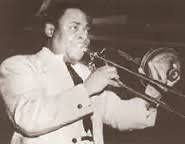
I would also have to rig up a mechanical toilet plunger mounted to the end of the horn’s bell, similar to the one used by Joe “Tricky Sam” Nanton, a famous trombonist who played in Duke Ellington’s band in the 30’s. Tricky Sam was a master at using the head from a toilet plunger to create amazing “wah-wah” sounds that no one else could replicate. I mean, if you’re going to have the controls of one of the loudest horns on earth at your fingertips, you might as well do it right!
I once heard a train near my house, travelling west from Conroe towards Navasota. The train’s horn seemed to be stuck in the “open” position, emitting just one long, continuous monotone blast. This went on for mile after mile, the whole time he was within earshot. Poor guy. Poor train crew! But later on I got to thinking, what if that was just some engineer’s exercise in creativity? Perhaps it was an old Engineer about to retire, who had just grown weary after thirty years of only the “L – L – S – L” routine and had decided to go for one masterful “LOOOOOOOOOOOOOONG” on his last day at work. A screwdriver jammed into the open valve handle, and there you go! What a magnificent way to top off a career!
There is a major rail line running alongside Kyle Field in College Station, Texas, where Aggie football games are played. When I was a student at Texas A&M, I can remember on most game days you would see a freight train passing by the stadium, and invariably you would hear the train engineer blast out the beginning sounds of the Aggie War Hymn, “Hullabaloo, caneck, caneck”, on the train horn, much to the delight of 50,000 crazy Aggies.
Some of you may be thinking that varying from the official, regulation train language could possibly create havoc and mayhem at railroad crossings. I would argue just the opposite. Seems to me that this freestyle horn blowing would automatically make trains more interesting to the average automobile driver, and thereby make drivers more aware as a train approaches a crossing!
So, if you are ever out and about and you hear a train horn blowing a little jazzy number from Glen Miller, or some freestyle musical scales that are a little non-conformist in nature, just picture me sitting in the cockpit of the locomotive, smiling in my colorful beach-print shirt. That just might be me in there, tooting my horn!
 Paul's Point of View
Love love love your writings! Makes me smile every time!
LikeLike
I’ve always loved train horns too. Love your analogy with the trombone! Looking forward to seeing y’all….TOOT TOOT!!😁
LikeLike
Love this, as usual!’
LikeLike