
Sometimes we humans need a good reminder of just how small we really are, and how big God is!
In the summer of 1977, between my junior and senior years in High School, I was enthralled by the launch by NASA of the Voyager 1 and Voyager 2 spacecraft. I remember taking a field trip to see a travelling NASA exhibit that came to Tyler Junior College during my senior year, which described the mission of these twin cosmic explorers. Their initial mission was designed to conduct closeup studies of Jupiter and Saturn, Saturn’s rings, and the larger moons of these two planets.
They were built to last five years. Incredibly, almost forty-four years later, they are still traveling through space today. The information they have returned to Earth over the years has truly revolutionized the science of planetary astronomy. Both of the twin spacecraft have now left our solar system, but are expected to continue returning valuable data for at least another decade, until their power sources can no longer supply enough electricity to function.
Mixed in all of the valuable scientific data that has been sent back from the Voyagers’ instruments, one particular item stands out, and the story of how it was captured is fascinating. It is a digital photograph, known as the “Pale Blue Dot” photo.
On February 14, 1990, Voyager 1 was about to leave our solar system. It had traveled 3.7 billion miles away from Earth by that time. Just before it crossed over and through the turbulent winds that ply the edges of our solar system, astronomer and author Carl Sagan begged the mission team to turn the camera around and take one last photograph of Earth across the vastness of space. He knew that such a photograph would not have much scientific value, since Earth would appear too small for the camera to make out any detail. However, he felt it would be meaningful in that it would give us a unique perspective on humanity’s place in the universe.
Program administrators finally agreed with Sagan, and the camera was turned around so that the digital image could be taken. The image data was held on the spacecraft’s on-board tape recorder for a while, and eventually transmitted back to earth. Even with the data signal traveling at the speed of light, it still took nearly five and a half hours for the data to be fully received. When it finally arrived and was processed, astronomers were stunned by what they saw. The Voyager camera had captured a large portion of space in its field of view, essentially blackness, nothingness. There in the middle of this vast darkness, caught in a random solar beam picked up by the camera, Earth appears as a small, pale blue dot. Of the 640,000 individual pixels that compose the completed image, the speck of dust that we call Earth takes up less than one pixel (0.12 of a pixel, according to NASA).
In 2020, for the image’s 30th anniversary, NASA released a new, cleaned up version of the original photo, using modern image processing techniques “while attempting to respect the original data and intent of those who planned the images”. Here is the image:
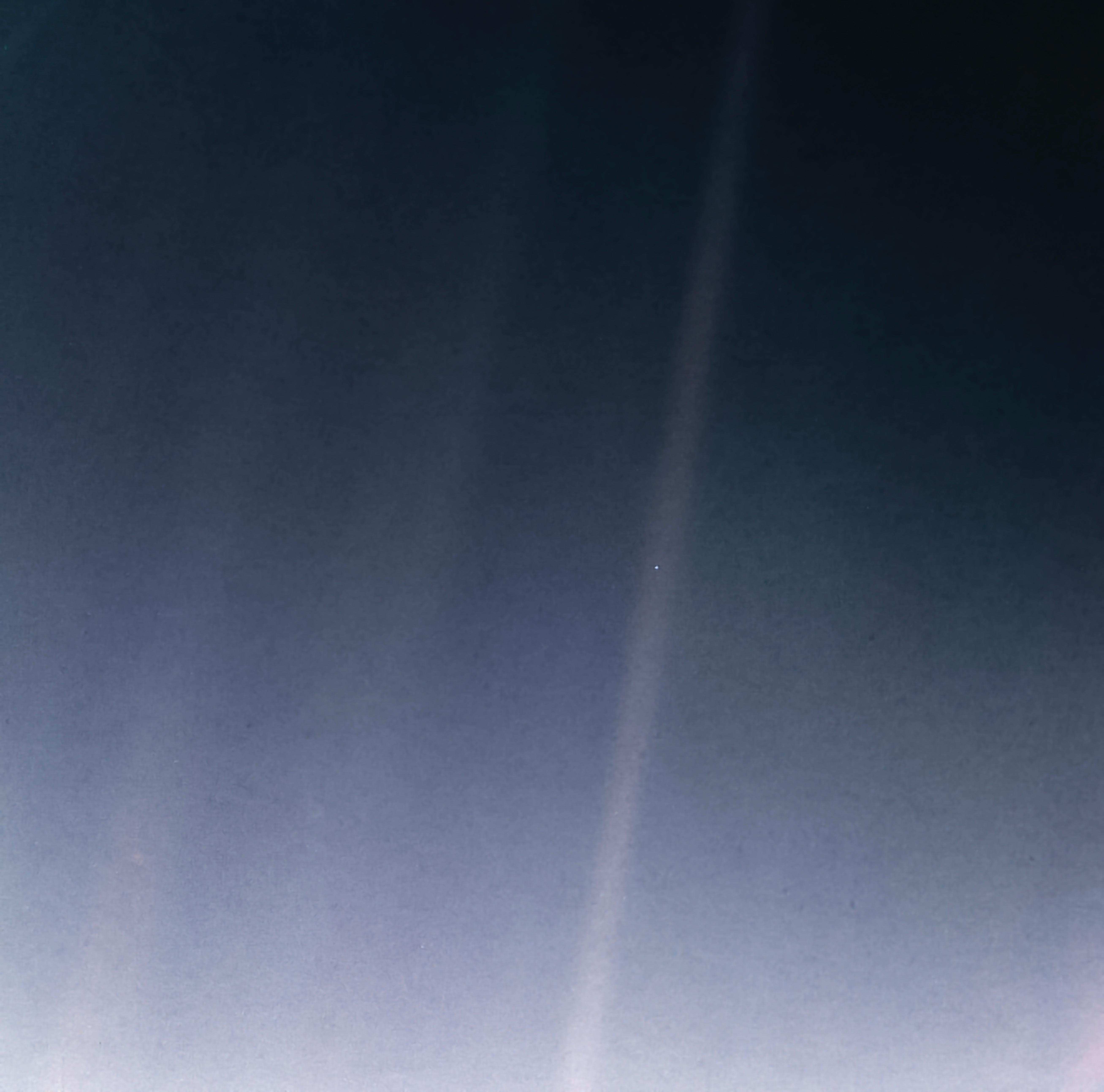
Can you see us there? (You may need to click on the image to enlarge it some. Look for the small dot, just to the right of center….that’s us)
In his 1994 book, Pale Blue Dot, Sagan comments on what he saw as the great significance of the photograph, writing:
“Look again at that dot. That’s here. That’s home. That’s us. On it, everyone you love, everyone you know, everyone you ever heard of, every human being who ever was, lived out their lives. The aggregate of our joy and suffering, thousands of confident religions, ideologies, and economic doctrines, every hunter and forager, every hero and coward, every creator and destroyer of civilization, every king and peasant, every young couple in love, every mother and father, hopeful child, inventor and explorer, every teacher of morals, every corrupt politician, every “superstar,” every “supreme leader,” every saint and sinner in the history of our species lived there–on a mote of dust suspended in a sunbeam.
The Earth is a very small stage in a vast cosmic arena. Think of the rivers of blood spilled by all those generals and emperors so that, in glory and triumph, they could become the momentary masters of a fraction of a dot. Think of the endless cruelties visited by the inhabitants of one corner of this pixel on the scarcely distinguishable inhabitants of some other corner, how frequent their misunderstandings, how eager they are to kill one another, how fervent their hatreds.
Our posturings, our imagined self-importance, the delusion that we have some privileged position in the Universe, are challenged by this point of pale light. Our planet is a lonely speck in the great enveloping cosmic dark. In our obscurity, in all this vastness, there is no hint that help will come from elsewhere to save us from ourselves.
The Earth is the only world known so far to harbor life. There is nowhere else, at least in the near future, to which our species could migrate. Visit, yes. Settle, not yet. Like it or not, for the moment the Earth is where we make our stand.
It has been said that astronomy is a humbling and character-building experience. There is perhaps no better demonstration of the folly of human conceits than this distant image of our tiny world. To me, it underscores our responsibility to deal more kindly with one another, and to preserve and cherish the pale blue dot, the only home we’ve ever known.
There have been times in my life when I’ve truly been humbled by the environment I was in. Once was when I was near Seattle, Washington, hiking at the foot of Mt. Rainier with Emory. We were in a snow covered valley, and at one point we got separated a little. I remember looking down the trail at Emory, and then up the trail towards the mountain peak. I felt like such a small part of God’s creation here on planet Earth.
Standing on the South Rim of the Grand Canyon had the same effect on me. As I moved my eyes from the tip of my hiking boots across that vast expanse to the other side of the canyon miles away, the magnitude of that gigantic chasm stretching out before me was truly hard for my mind to fathom.
Next week we have the opportunity to return to Big Bend National Park. Like Mt. Rainier or the Grand Canyon, Santa Elena Canyon in Big Bend is an equally humbling spectacle that makes me feel incredibly small every time I’m there. Along either side of the Rio Grande river, towering cliffs up to 1,500 feet tall line the river. Standing on the river bank, a bird’s shrill whistle or a human’s call will seemingly echo forever as the sound waves bounce back and forth between these gigantic limestone walls. If the clouds cooperate, we’ll also have an opportunity to view the stars on a moonless night in the middle of the desert, in one of the darkest skies in our part of the world. That experience will also make you feel pretty small!
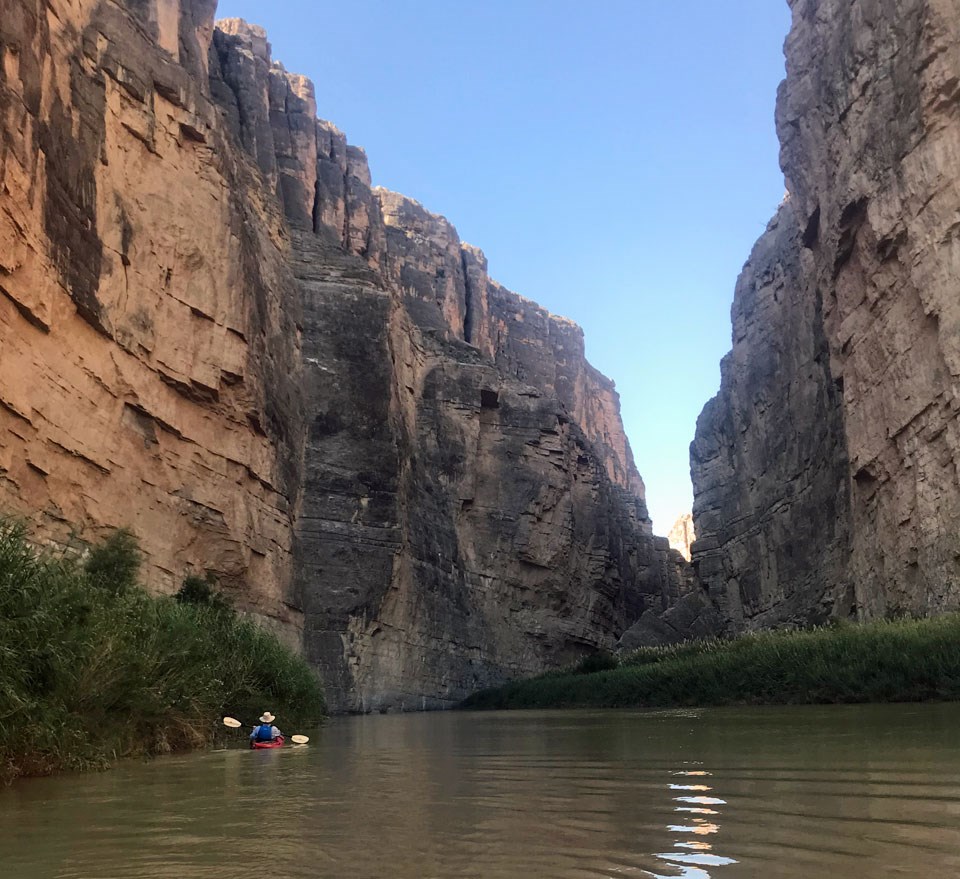
Our planet is full of awe-inspiring, magnificently grand scenes that put us in our place as far as size, grandeur and overpowering scale. But when you view these things in the context of the Pale Blue Dot image, even these oversized examples of God’s handiwork here on Earth become miniscule. When taken in complete scale with the Pale Blue Dot image in mind, the Santa Elena Canyon would be thousands of times smaller than even the smallest wrinkle I see on my hand as I type this.
How big is God, and just how small are we? Atheists have long used the vastness of the universe as an argument that there couldn’t possibly be a God that cares about us humans, such an insignificant, small part of something so much larger. How could the creator of all of this be so intensely interested in us that he’s “numbered the hairs on my head” (Luke 12:7)?
The grand scale of the universe only proves the power, size and capabilities of our great Creator. When it comes to God’s interest in us, we can’t confuse “scale” with “significance”. As one writer put it, that would be like us ascribing a greater significance to a mountain than to a human baby simply because the mountain is 7 orders of magnitude larger than the baby.
The Pale Blue Dot photograph helps us to see the vastness, the infinity of God. It enlarges our view of God. The next time you find yourself feeling small and insignificant, whether it’s because you’re standing in awe of something grand in the natural world, or because life has just left you feeling small, remember the Pale Blue Dot photograph, and remind yourself just how truly big God is!
 Paul's Point of View
Paul- this is fascinating stuff not to mention the quality of the writing. When do you find the time to pull posts like this together?
LikeLike
Thank you Paul for you inspiring words. I look forward to reading them.
LikeLike
Thank you Paul for your amazing perspective and reminders of the awesomeness of God in our (his) world.
LikeLike
Beautiful post!
LikeLike
Paul––Another wonderful, thoughtful, well-written essay! I’m so glad that you share these “thoughts,” since they’re so much more than (just) that. Hope all’s well with you and yours … Looking forward to your next one––Brian
LikeLike
I enjoyed reading this so much! You truly have a gift. I’ll think about the Pale Blue Dot each time I start worrying about little things. Thank you for sharing your thoughtful article!
LikeLike